Exercise: Map your customer’s journey
To carry out this exercise, you should download the customer’s journey template:
- Start by identifying your buyer persona. Use the section above to describe him/her by elaborating a portrait through questions like who he/she is, what he/she does for a living, etc.
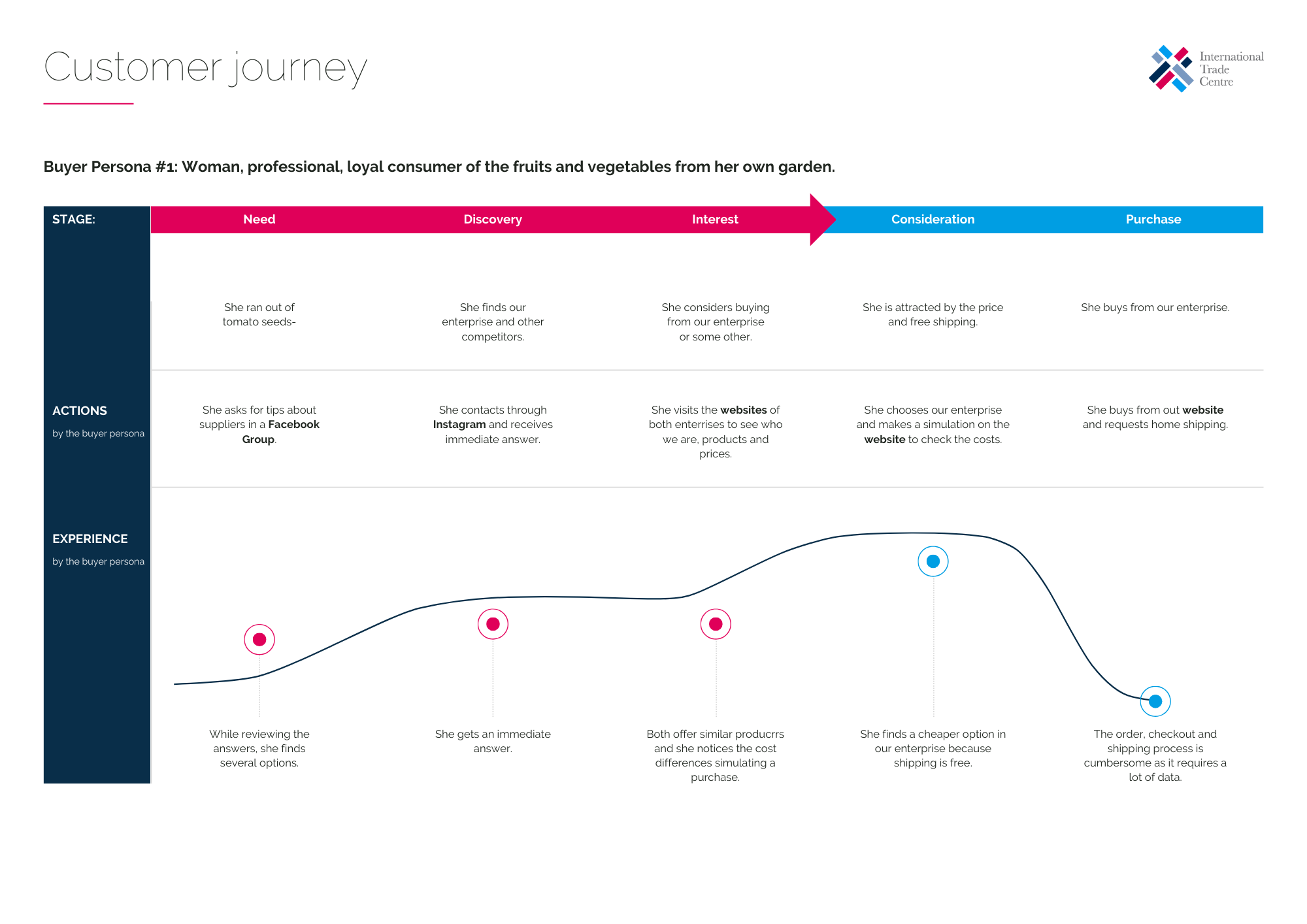
- The second section helps you understand the interaction stages that the customer goes through from the moment he or she detects a need until the purchase of the product or service. To better reflect this part, forget your own enterprise processes. This experiment is about understanding the stages the customers perceive in their real experience.
- After that, identify your actions on each of those steps. What must you do in order to achieve your goal?
- Continue with the section that describes what the experiences are like, which is a critical section. At that point, it is time to talk about emotions when interacting with the enterprise. Describe what moves the customers on each step, what they like, what they expect and why, what worries them, what generates doubts on them, what frustrates them or the problems they encounter.
Also, state the touch point from which they have this experience (website, app, mail, phone, physical store, etc.). Then, mark the points that represent their emotions (the positive ones on the upper area, the neutral ones at mid-height and the negative ones on the lower part). After that, join the dots with lines and plot a diagram or curve to graphically represent the emotions the customer experiences.
- For the last section, opportunities, you should evaluate those points on which the customers are confused, angry or satisfied, which are decisive for them to continue onto the next phase.
By identifying them, you will be able to understand the things you can do to help the customer have a better experience. The idea is that you see improvements through the design or redesign of your product or service, understanding those factors or situations that “bother” the customers.
Once you understand how they feel on each step of the journey and on their interaction with each touchpoint, you will realise that each of those factors or situations represent an area to greatly optimise the customer experience.
Note your conclusions in this section.
Here is an example of what your template could look like after completing this exercise: